The first mistake is reading philosophy like a novel.
You wait for the plot. There isn’t one. You wait for the characters to develop. They don’t. You finish the chapter, close the book, and discover you cannot remember what the argument was — only that it sounded serious.
Ancient philosophy asks something different of you. It is not a story to follow. It is a claim to test. And a claim is easier to test when you have a pen in your hand.
Why ancient philosophy is slow
Three things make it slow.
The text is a translation. Every English Plato is somebody’s Plato. The translator chose justice instead of rightness, soul instead of breath, virtue instead of excellence. Those choices are not neutral. Reading with a pen means noticing them.
The text is often a fragment. Heraclitus survives in quotations, reports and paraphrase. The women philosophers survive mostly as testimony — a line quoted by someone else, centuries later. You are not always reading the author. Sometimes you are reading the hand that passed the author on.
The text is an argument, not a mood. A sentence that sounds beautiful may be doing careful work. A sentence that sounds obvious may be the one that overturns the page.
Slow is not a failure. Slow is the method.
The four moves
This is the method I use for one page at a time. It fits in ten minutes, and it works better than reading fifty pages without a pencil.
1. Mark the claim
Underline the sentence the page is actually asking you to accept or reject. Not the prettiest sentence — the load-bearing one.
Then write in the margin: What is this sentence claiming?
A claim is not a theme. “Heraclitus thinks everything changes” is a theme. “You cannot step twice into the same river” is a claim about identity, time and the self. Make it specific enough that someone could disagree with you.
2. Question the translation
Find one word that feels too smooth. Ask what the Greek or Latin might have been doing before the translator made it English.
You do not need to know Greek. You need to notice when a word is carrying more weight than it can bear. Virtue is a good place to start. So is happiness. So is nature.
Write the alternative in the margin. Read the sentence again with the alternative. Does it still hold?
3. Restate it plainly
Close the book. Say the argument out loud in one sentence, as if you were explaining it to a friend who has never read philosophy.
If you cannot, you have not understood it yet. Go back to the claim. Find the step that is missing.
This is the move people skip. It is also the move that turns reading into thinking.
4. Test it against one thing
Choose one ordinary thing: a conversation you keep replaying, a decision you are avoiding, a habit you defend.
Ask: Does this claim make that thing look different?
If yes, write one line about how. If no, write one line about why not. Both are useful. A philosophy that cannot touch an ordinary Tuesday is not yet yours.
A worked page: the river
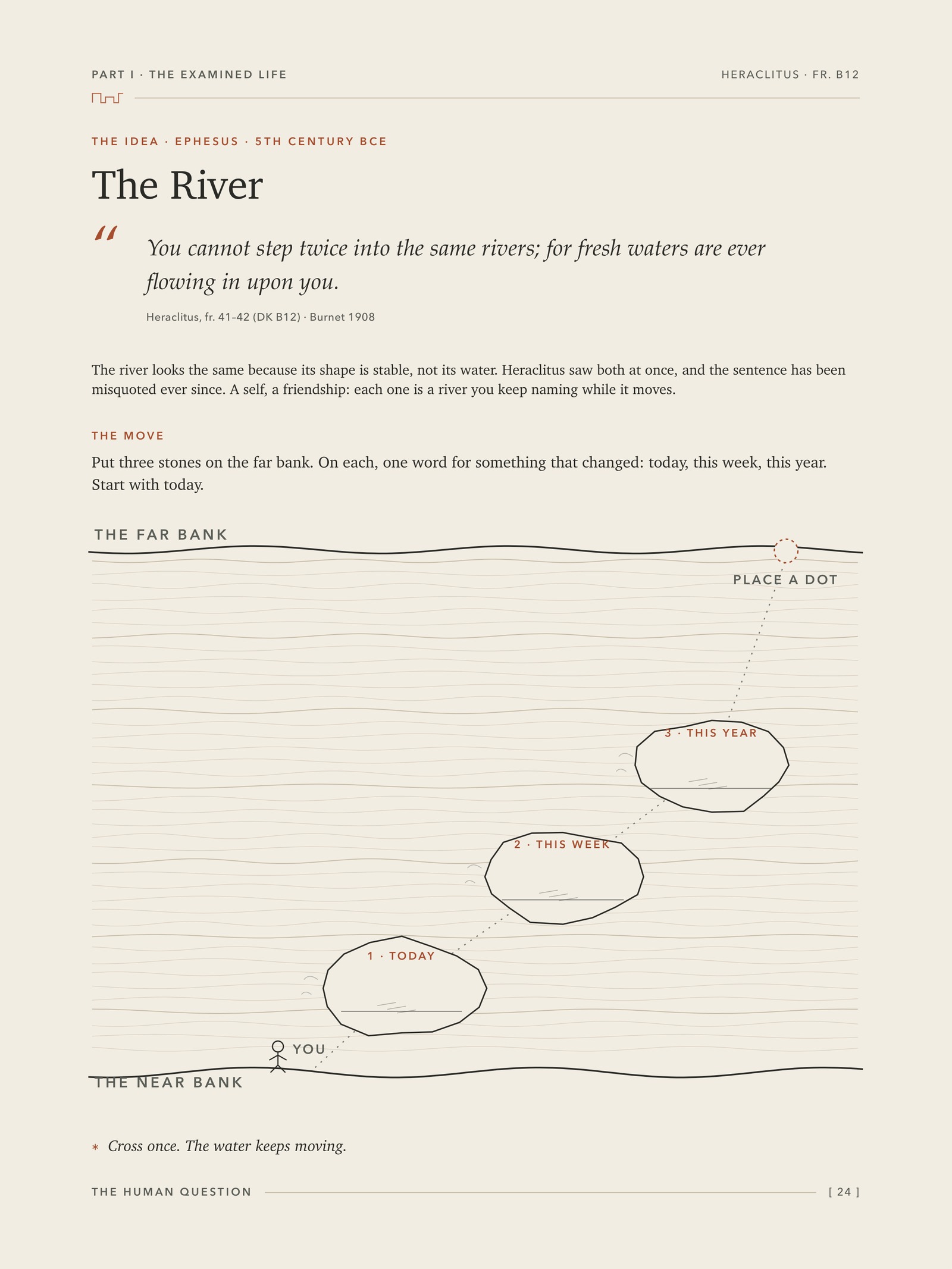
Here is the page from The Human Question — the River, from the Heraclitus section.
“You cannot step twice into the same rivers; for fresh waters are ever flowing in upon you.”
Heraclitus, fr. 41–42 (DK B12), trans. John Burnet, 1908
The page does not ask you to admire the sentence. It asks you to put three stones on the far bank.
On each stone, one word for something that changed: today, this week, this year. Start with today. Then cross once. The water keeps moving.
That is the whole exercise. It is also the whole argument: the river looks the same because its shape is stable, not its water. You are a river you keep naming while it moves.
The page has a form because the idea has a form. A paragraph about flux would have been easier to skip. Three stones are harder to ignore.
What not to do
- Do not highlight the whole page. A page of yellow is a page you have not read.
- Do not start with the summaries. A summary can tell you what Plato said. It cannot tell you what you think about it.
- Do not collect quotes without their sources. The internet is full of beautiful lines that no ancient author ever wrote. If a quote has no work, section and translator, treat it as a rumour.
- Do not try to finish. Ancient philosophy is not a course with a finish line. It is a set of questions that get more useful the longer you carry them.
A reading session that fits a life
Ten minutes. One page. One pen.
- Read the quotation twice. The second time, read it as an argument, not a motto.
- Mark the claim.
- Write one question in the margin.
- Restate the claim in your own words.
- Test it against one thing from today.
- Close the book. Leave the question open.
That is enough. The page is done; the question stays open.
If you want a page built for this — one idea, one context, one move, one finish — The Human Question is a 200-page writing book from Athens to Rome.