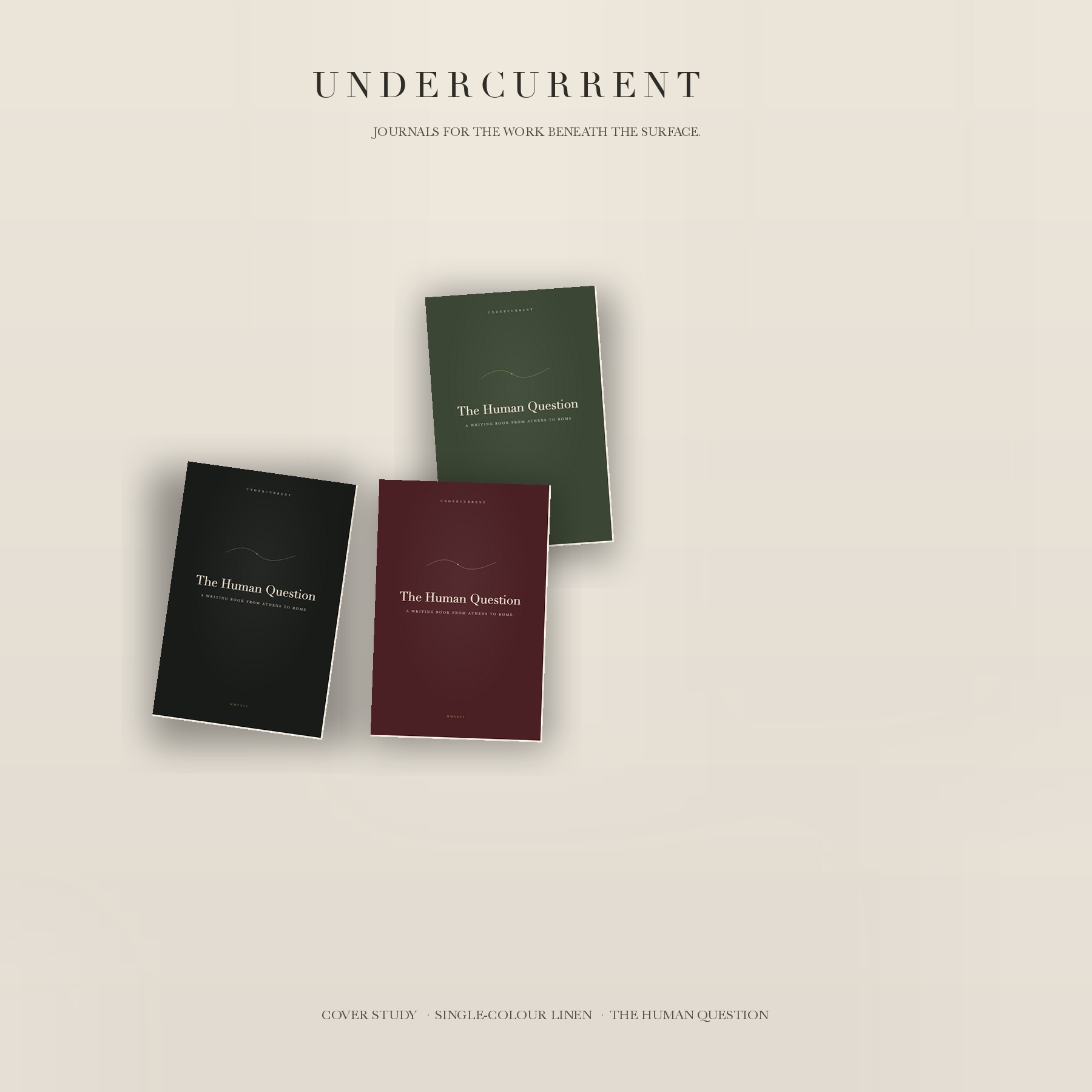
The philosophy reader in your life already has the Republic. They have a copy of the Meditations with somebody else’s notes in it. They have the Oxford Very Short Introduction, and the Cambridge Companion, and a tote bag from a conference they went to once.
What they may not have is a book that asks them to write back.
What makes a good philosophy gift
A good philosophy gift is not a louder edition of a book they already own. It is an object that changes what they do with the reading.
Look for three things:
Use. Does it ask something of the reader? A book to mark, a set of exercises, a page with a question on it — these do more than another survey.
Specificity. “Philosophy” is not a taste. Ancient philosophy, Stoicism, the Presocratics, the cave, the consolation of mortality: pick one door and walk through it.
Honesty. Does the object name its sources? Does it distinguish a quotation from a paraphrase? Does it admit what is lost? A gift that respects the reader’s intelligence is worth more than one that flatters it.
Three readers, three gifts
The classics student
They are already reading the texts. What they need is permission to write in them.
A writing book gives them a place to test the argument instead of memorizing it: mark the claim, question the translation, restate it plainly, apply it to one ordinary thing. It is the difference between having read the Apology and having argued with it.
Give: a book they can mark without feeling guilty. The Human Question is designed for this — 200 pages, 37 encounters, one page at a time, with a form for each idea.
The Stoic practitioner
They have read Meditations. They may have a favourite translation and a strong opinion about prohairesis. What they do not need is another paperback of the same text.
They need exercises: the evening review, the control audit, the view from above. Small practices, done at a fixed hour, with a page that asks for one honest answer rather than a performance of calm.
Give: a practice book, not a quote collection. The Roman Practice section of The Human Question is built around the lamp, the ledger and the sentence you carry into tomorrow.
The lapsed philosophy major
They miss thinking. They do not miss the syllabus.
The books that bring them back are not surveys. They are objects that make one old question usable again: a page on Heraclitus, a cave to draw, a tribunal for the quotes that were never said.
Give: a way back in that does not feel like coursework. A book they can open anywhere, mark, and close without guilt.
The object
The Human Question is a 200-page writing book from Athens to Rome.
- 4 parts, 37 encounters, one page = one ancient idea + one move + one finish
- Public-domain translations with translator, work and section
- Women philosophers and non-mainstream voices included, with testimonies labelled
- A fake-quote tribunal, timeline, who’s-who, source ledger and index in the back
- iPad PDF and print-ready PDFs at US Letter, A5 and US Trade. No A4.
- $19.99 USD, digital edition; instant download; nothing ships
It is not a journal, a textbook, a therapy workbook or a quote collection. It is a writing book for the reader who wants the old questions to become usable again.
What not to give
- Another introduction. They already know the map. Give them a place to walk.
- A quote card. A sentence on a card is not a practice. If the quote is fake, it is also a small insult.
- A blank journal. A blank page asks them to invent the question. This book supplies the question and the form.
- Anything that calls itself “philosophy for dummies.” The reader in your life is not a dummy. They are tired of being explained to.
- A fake leather “Stoic” notebook with a Marcus Aurelius quote on the cover. Especially if the quote is not Marcus Aurelius.
How to give it
Start with the sample. It is free, seven pages, and it shows the form better than a description can.
If they like the sample, the full book is one download: four PDF editions, no shipping, no waiting. It is a digital object, so it works best for the reader who already reads on a tablet or prints at home — or for the reader who wants to start tonight.
You can send them the 7-page sample or see the book.
If you want a page built for this — one idea, one context, one move, one finish — The Human Question is a 200-page writing book from Athens to Rome.