Most “Stoic journaling” advice is journaling with a laurel wreath on it.
A notebook. A prompt. A page of feelings. Nothing wrong with that — but it is not what Seneca, Epictetus and Marcus Aurelius were doing. Their practice was closer to a drill than a diary: a few questions, done at a fixed hour, with a pen and a small amount of honesty.
The exercises below take five to ten minutes. You do not need a journal. You need one page, or one index card, and the willingness to answer a question without defending yourself.
First: what a Stoic exercise is
The Greek word is askēsis — practice, training, exercise. Not self-expression. Not a record of the day. A deliberate act repeated until it changes how you meet the next hour.
That is why the exercises are small. A practice you can do on a bad day is worth more than a ritual you can only do when life is calm.
Exercise 1 — The evening review
Seneca, in On Anger, describes the spirit being brought up for examination daily. He borrowed the habit from Sextius: before sleep, read the day back while it is still warm.
The three questions are plain:
“What bad habit of yours have you cured to-day? what vice have you checked? in what respect are you better?”
Seneca, On Anger 3.36, trans. Aubrey Stewart, 1889
Do not turn this into a diary. One line per question. No story, no defence, no speech for the prosecution.
- A habit I put down today:
- A vice I checked:
- One respect in which I am better:
Then stop. The point is not to feel bad about the day. The point is to see it clearly enough that tomorrow has a choice.
If nothing comes, write nothing yet on the first line. That is an honest answer, and it is more useful than a paragraph of self-improvement.
Exercise 2 — The control audit
Epictetus opens the Enchiridion with a division so plain it is almost rude:
“Of things some are in our power, and others are not. In our power are opinion, movement towards a thing, desire, aversion…: not in our power are the body, property, reputation, offices…”
Epictetus, Enchiridion 1, trans. George Long, 1877
Draw two columns, or two rings. Put one thing in the left column: something that is actually yours to decide today. Put one thing in the right: something you keep checking that was never yours.
The left column is usually smaller than we expect. It is also where the day is decided.
Do not write a list of everything you cannot control. That becomes a complaint with headings. Write one thing on each side. Then take one action on the left side before noon.
Exercise 3 — The view from above
Marcus Aurelius, in the Meditations, climbs in imagination and looks down:
“Look down from above on the countless herds of men and their countless solemnities, and the infinitely varied voyagings in storms and calms…”
Marcus Aurelius, Meditations 9.30, trans. George Long, 1862
From that height, the week’s emergency becomes one lit window among thousands. The view does not make the week unimportant. It makes it smaller than the fear.
Write three lines:
- What shrinks from up here?
- What keeps its size?
- What can you see only from up there?
Then come down. Pick one thing to do differently today. The exercise is not a mood; it is a change of proportion.
How to practice without a journal
You do not need a bound notebook, a streak, or a beautiful spread. You need a surface.
- One page, one exercise. Do one of the three, not all three.
- Same hour. Evening review before bed; control audit before the day starts; view from above when the week has become a wall.
- No tracking. A streak turns a practice into a performance. If you miss a day, the page waits.
- One sentence of evidence. Write what you actually did, not what you intend to do.
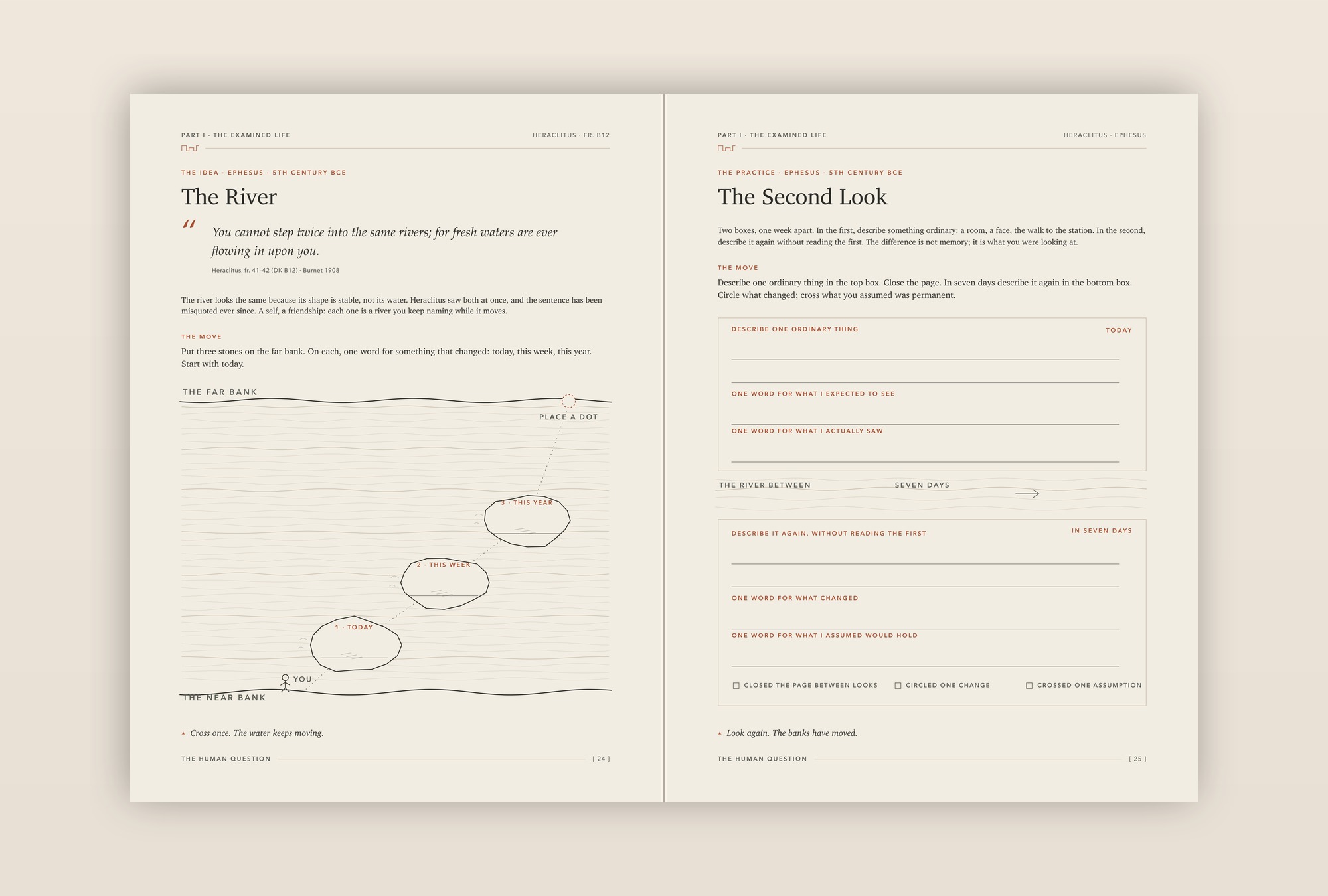
If you want a page designed around the exercise rather than a blank page beside it, The Human Question has a form for each idea. The Roman Practice section includes the lamp, the ledger, the morning audit and the view from above. You can open the 7-page sample or see the book.
What Stoicism is not
It is not the suppression of feeling. The Stoics had a great deal to say about emotion; they did not pretend it was absent.
It is not a productivity system. A calm life is not the same thing as an optimized one.
It is not therapy. If you are in crisis, these exercises are not a substitute for care.
It is not a set of quotes for your mirror. A sentence on a mug is not a practice.
If you want a page built for this — one idea, one context, one move, one finish — The Human Question is a 200-page writing book from Athens to Rome.