A writing book · Undercurrent · 2026
The Human Question — A Writing Book from Athens to Rome
One page. One ancient idea. One move.
There is a question under every philosophy book: what does it mean to be human.
Most books answer it. This one gives you a pen.
A 200-page writing book from Athens to Rome. 37 ancient thinkers, one page, one move — mark it, answer it, close the page.
Instant download. One ZIP with the iPad PDF and three print-ready editions — US Letter, A5 and US Trade. No A4. This is a digital edition; nothing ships.
The old questions
The old questions are still warm
They are not museum pieces. They are still rude at dinner. Still capable of turning a good afternoon inside out. Still asking what you mean when you say I, mine, enough, a good life.
The Human Question is a 200-page writing book from Athens to Rome. It puts one ancient idea on each page and asks you to do one thing with it: mark a stone, cross out an expectation, draw a line to the fire, write the sentence you would not say aloud.
Each page gives you a short quotation in a public-domain translation, a few sentences of plain context, and a single move. Then a finish line tells you when the page is done. No streak. No catching up. You can open anywhere.
It is not a journal. A journal asks how your day went. This book gives you an old idea and asks what you are going to do with it.
It is not a textbook. It does not ask you to remember the Presocratics. It asks you to use one.
It is not therapy. It does not diagnose, treat or replace care.
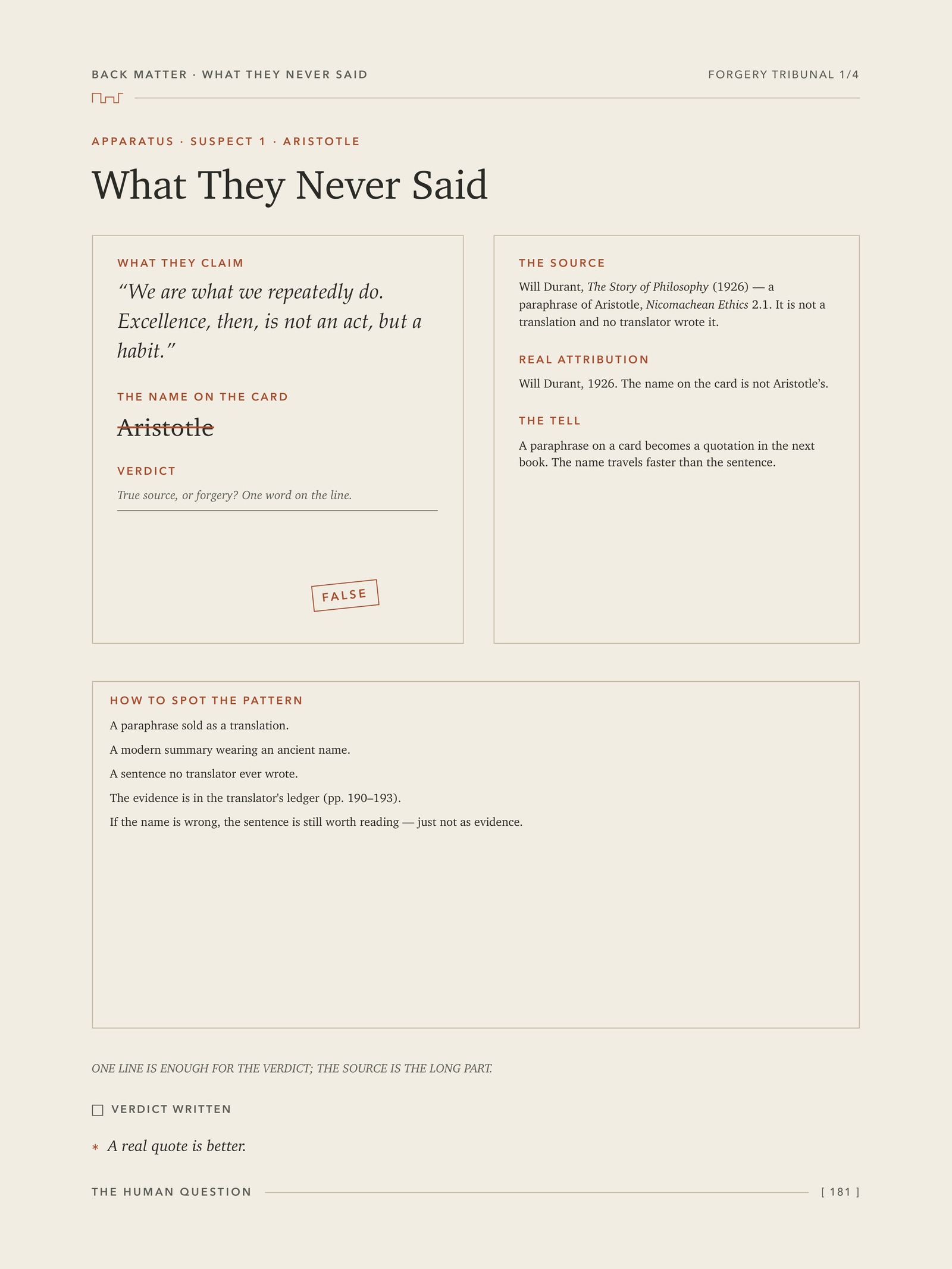
It is not a quote collection. Every quotation is attributed; the back of the book includes a tribunal for the ones that were never said.
It is a writing book for thinking — for the reader who wants the old questions to become usable again.
Structure
Four parts, from Miletus to late antiquity
The Examined Life
The Presocratics, Socrates, Plato, the Sophists, the Cynics, and the women whose arguments arrive as fragments and testimony. The part where philosophy begins in the street and ends in a question.
The Art of Living
Aristotle, Epicurus, the Stoics, the Skeptics, and the long argument about what makes a life go well, conducted as if it mattered.
The Roman Practice
Cicero, Seneca, Epictetus, Marcus Aurelius. Philosophy as a daily exercise: the lamp, the ledger, the sentence you carry into tomorrow.
The Inner Cosmos
Plotinus, Iamblichus, Hypatia, Boethius, Augustine. The inward turn, and the last light of the ancient schools.
A route, not a survey. You can enter anywhere. The book will still be holding the thread when you come back.
Inside
A book you mark, not just read
Every page has its own form, derived from the idea it carries. The shared layer is only the header, type, palette, footer and attribution. The form is the product.
- 200 pages, 37 encounters with ancient thinkers, 4 parts
- One idea, one context, one move, one finish per page
- Mark / tick / circle / draw / short-field moves; only a handful of longer free-writes
- Verified public-domain quotations with translator, work and section
- Women philosophers and non-mainstream voices included, with testimonies labelled
- A fake-quote tribunal, timeline, who’s-who, source ledger and index in the back
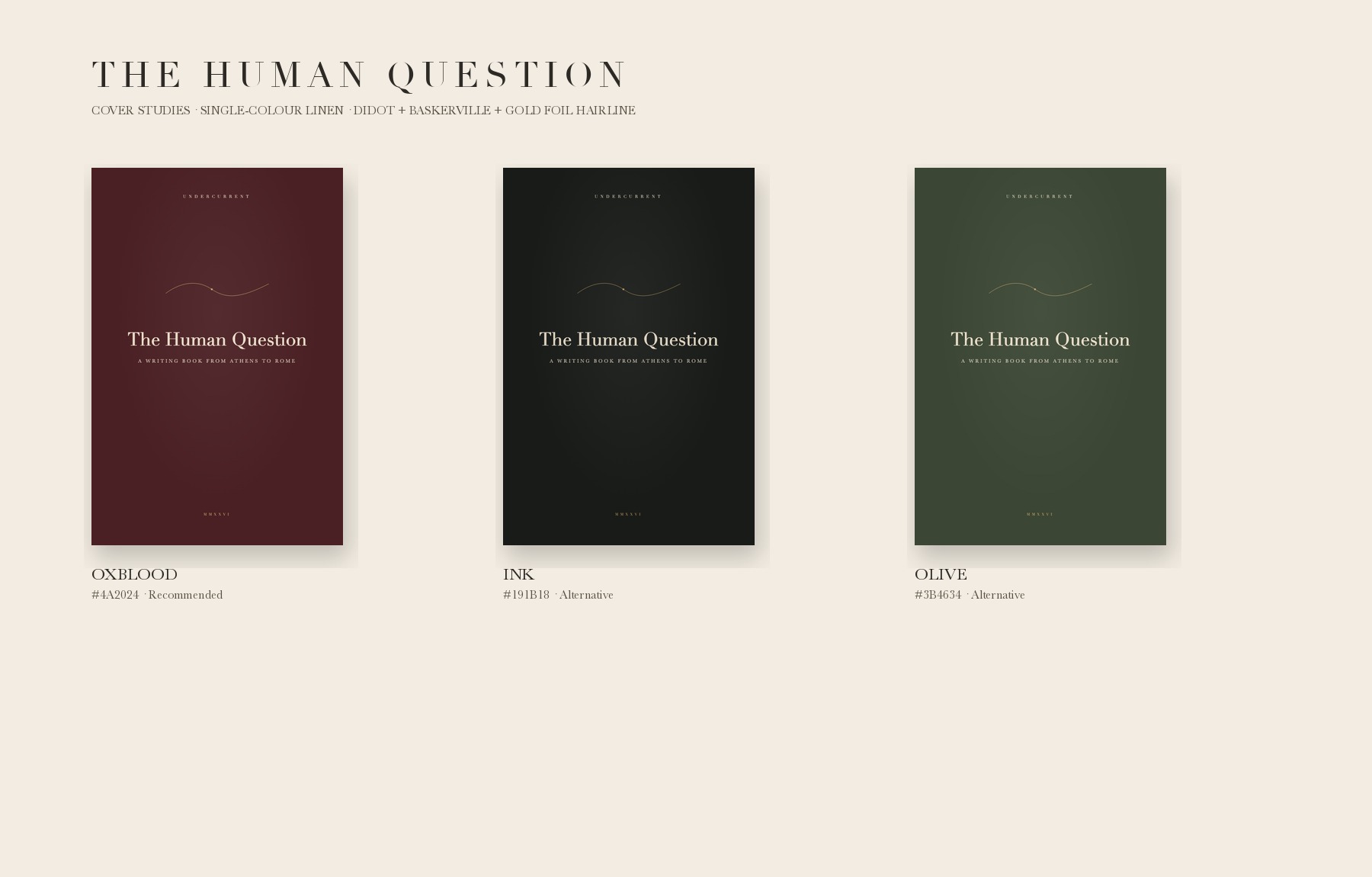
- A single-colour cover; cream paper; designed to be written in
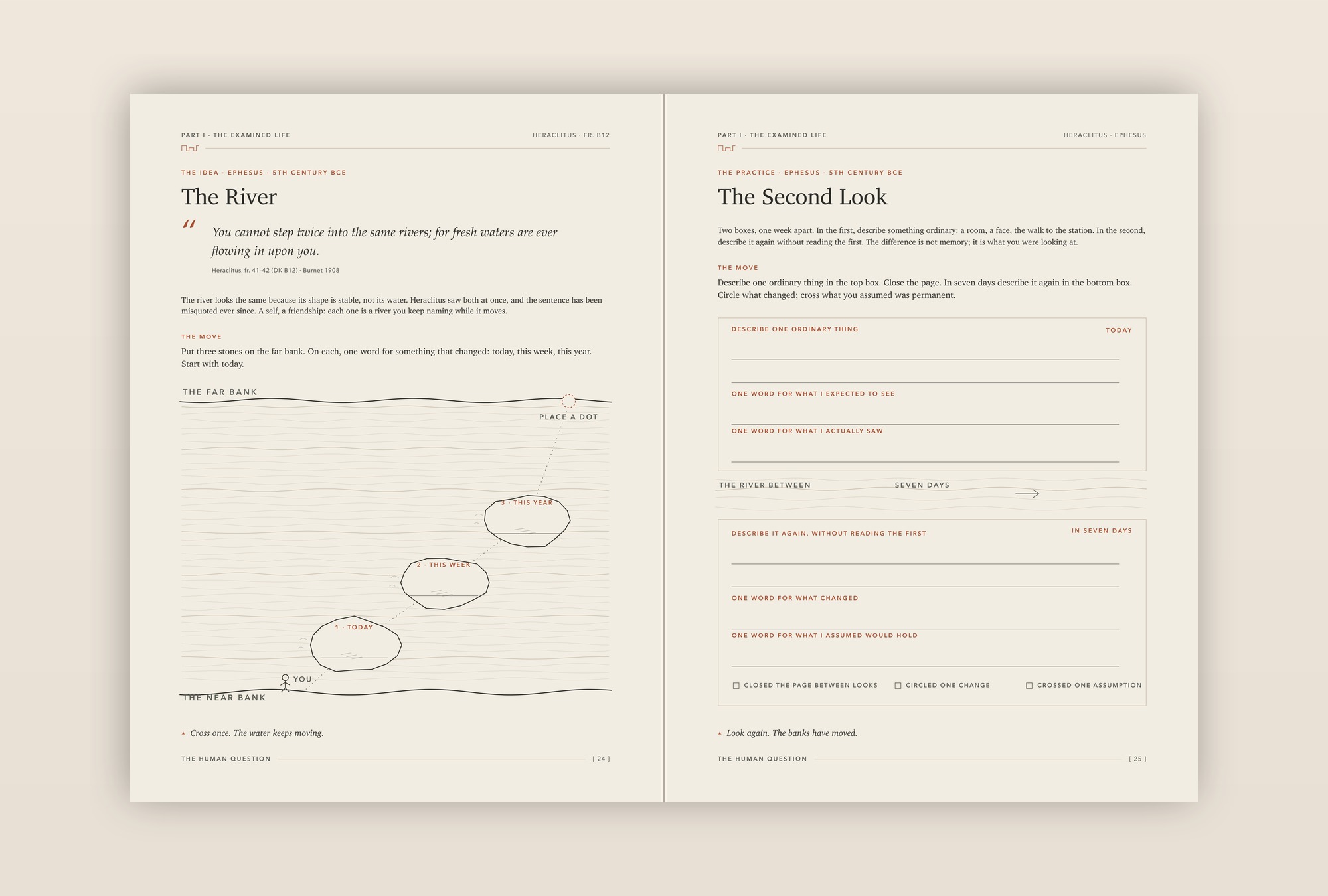
Look inside
Different pages, different forms
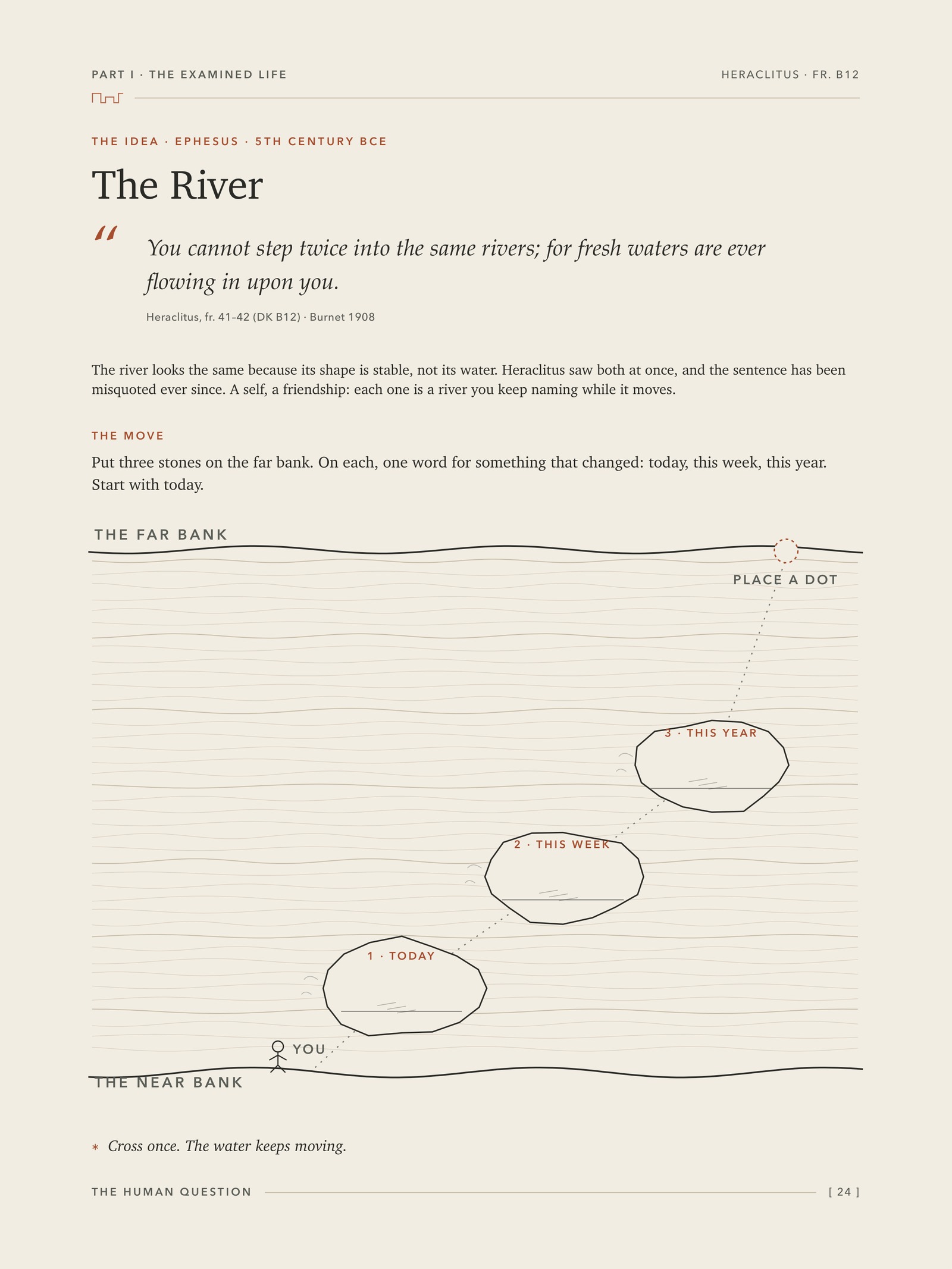
The River
Three stones to the far bank. One word for what changed today; one for this week; one for this year. Cross once. The water keeps moving.
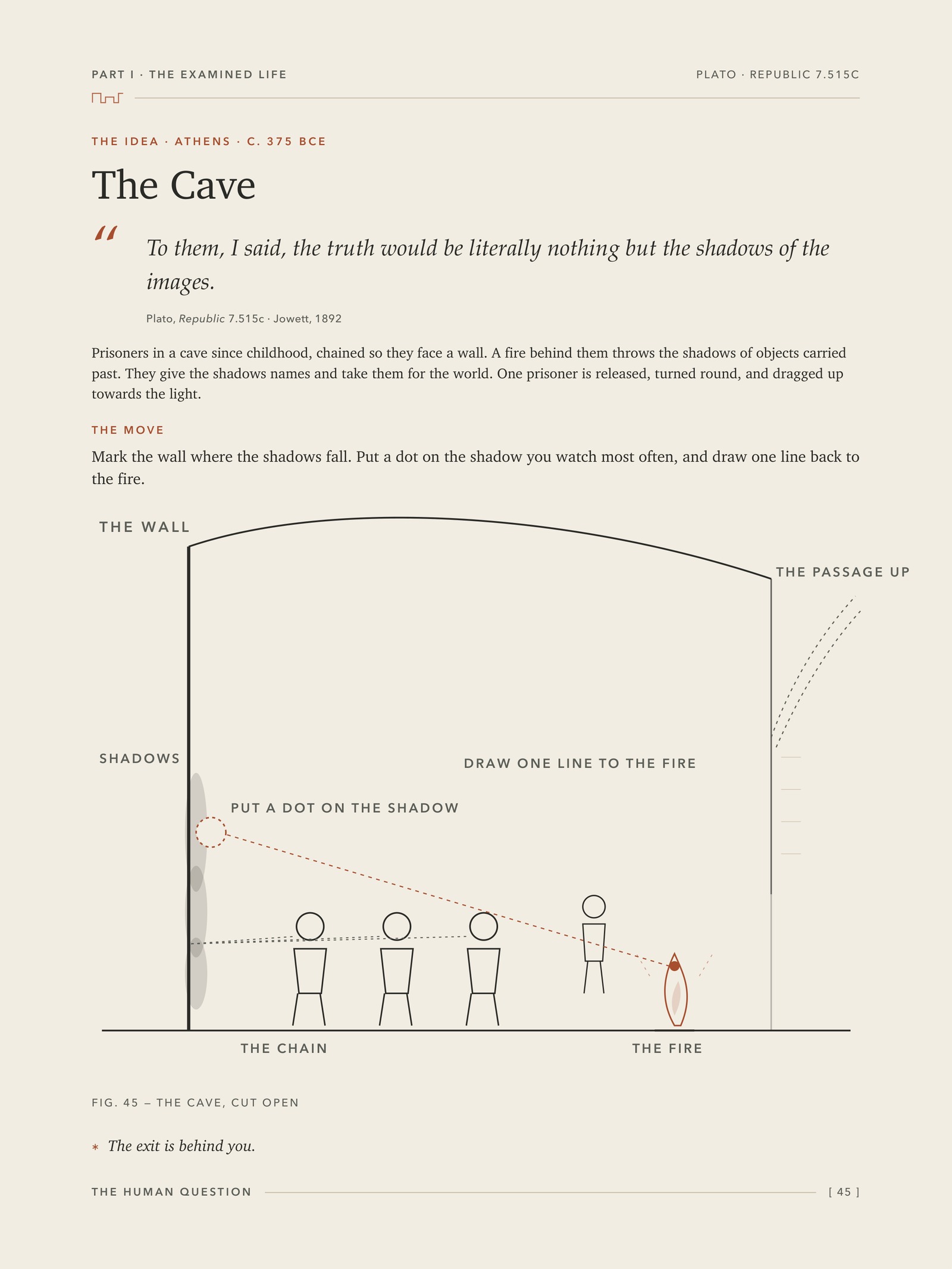
The Cave
Mark the shadow you watch most often. Draw a line back to the fire. Name the exit you already know about.
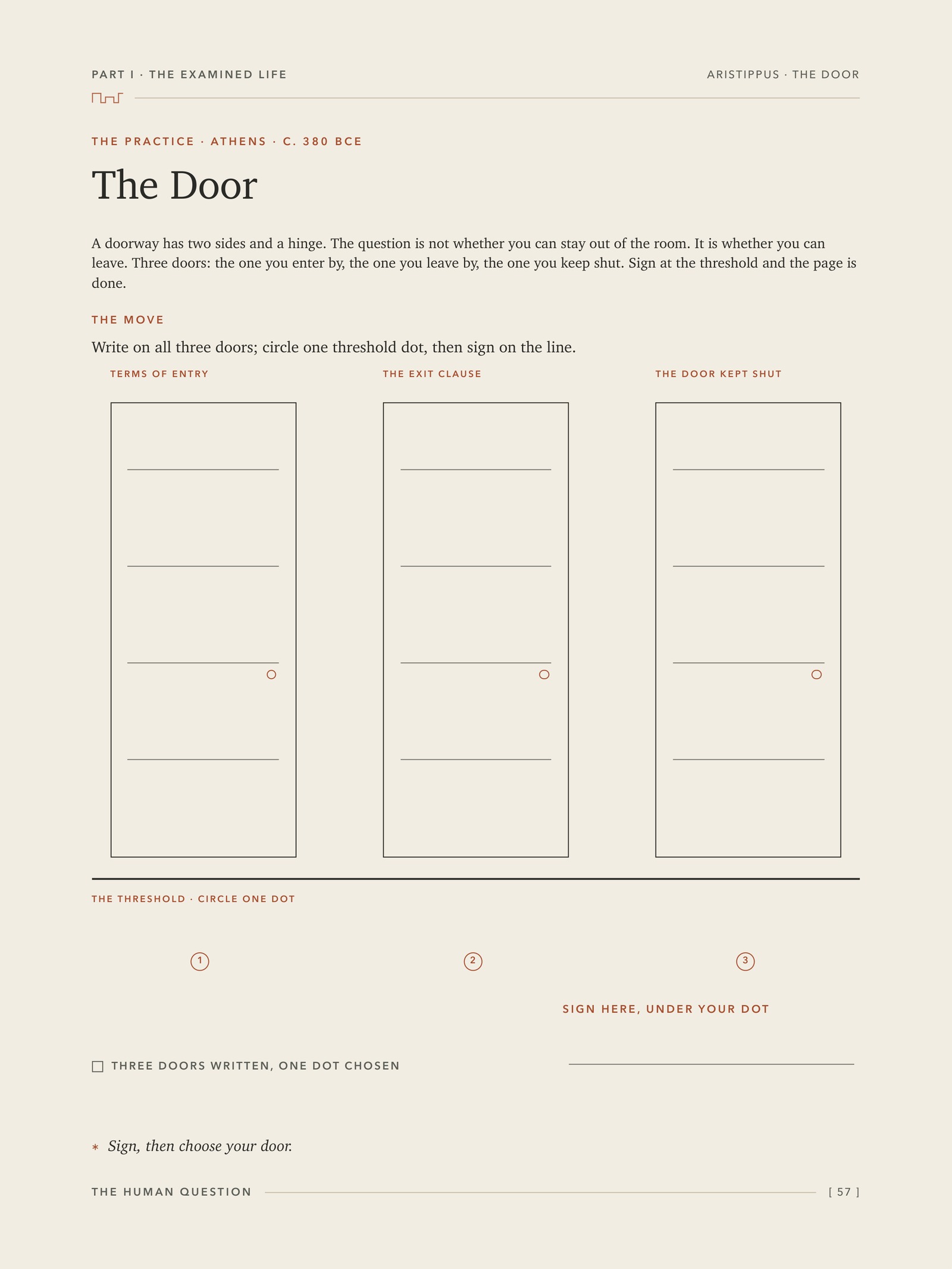
The Door
Three panels, one threshold. What you carry in. What you leave outside. What you are not ready to name yet.
The Tribunal
Real quotes, labelled fakes, and the small industry of sentences that were never said. Learn how a line gets dressed up as ancient.
The Cover Studies
Oxblood, Ink and Olive. Oxblood is the edition; Ink and Olive are alternates.
The apparatus
A note on the quotes
Every quotation is printed with its translator, work, section and year. Public-domain translations are used; lines that survive only as reports are labelled as testimonies. Nothing is retyped from a modern edition.
The back of the book includes a fake-quote tribunal — the place where common misattributions are marked and given their real author — plus a timeline, a who’s-who, a source ledger and an index. The apparatus is not decoration. It is how the book keeps its promises.
How it works
How it works
Open anywhere
No streak. No catching up. The first action is small.
Read the page
A short quotation, a few sentences of context, one move.
Do the move
Mark, draw, choose, or write the line. The page is a surface, not a test.
Stop at the finish
The page is done. The question stays open.
Editions
Editions and specifications
The quote policy: public-domain translations only; every quotation carries translator, work and section; fake quotes are labelled with their real authors.
Who it’s for
For readers who want to think with a pen
For the reader who has read the introductions and wants to argue with them.
For people who think with a pen, not a highlighter.
For the classics student who wants a book they can ruin.
For the gift buyer who knows the difference between a book and a prop.
Not for the reader who wants a blank journal, a quote-a-day deck, a therapy workbook, or a book that stays clean.
Questions
Good to know
Is this a journal?
No. A journal asks you to record the day. This book gives you one ancient idea and one move; the writing is how you think with it.
Do I need a philosophy background?
No. Each page has a short quotation, a plain-language context, and a single action. The reading is small on purpose.
How long does a page take?
Usually five to ten minutes. Some pages are mark-only; a few are longer free writes.
Can I write in it?
That is the point. The pages have generous writing surfaces, marks, ticks, circles and short fields. In the print editions, write on paper; in the iPad edition, annotate the PDF.
Is it therapy?
No. It is a writing book for thinking. It does not diagnose, treat or replace care.
Are the quotes real?
Yes. Every quotation carries its translator, work and section. The back has a fake-quote tribunal that marks common misattributions and gives the real author.
What formats are available?
iPad PDF, and print editions at US Letter, A5 and US Trade. No A4. The download is one ZIP containing all four PDFs.
A book you mark, not just read.
200 pages, 37 encounters, one page at a time. Start with the sample, or take the whole book.